


Healthcare SaaS startups operate under fundamentally different constraints than typical B2B SaaS companies. Unlike other markets where startups can begin with SMB customers and lighter security expectations, healthcare requires enterprise-grade security from day one, regardless of company size.
Any organization handling protected health information (PHI), including SMBs, is subject to strict regulatory scrutiny and near-zero risk tolerance. Even a breach affecting fewer than 500 patients must be reported within mandated timelines, making security and compliance non-negotiable from the outset.
In this post, we’ll break down the key differences between Healthcare SaaS and Traditional SaaS, along with the unique challenges and impact each presents. In the second part of the blog, we’ll introduce a progressive framework to help startups systematically meet the requirements of large healthcare providers.
Healthcare SaaS vs Traditional SaaS: Key Differences
The Challenge: Day-One Enterprise Expectations
Traditional SaaS Path:
- Start with SMB customers who have modest security requirements
- Build incrementally from basic security to enterprise-grade
- Mature security posture as customer size increases
- Timeline: 3-5 years to reach enterprise readiness
Healthcare SaaS Reality:
- Must target hospitals, health systems, and payers from day one
- Enterprise security requirements are table stakes, not aspirational
- No “stepping stone” customer segment exists
- Timeline: Must achieve compliance within 6-12 months to be viable
Real-World Risks: When Healthcare Data Breaches Hit Hard
- myNurse, a healthcare startup offering chronic care management, announced it will shut down following a data breach that exposed users’ personal health information.
- https://techcrunch.com/2022/05/02/mynurse-data-breach-shut-down/
- In 2024, Change Healthcare faced a massive ransomware attack that exposed PHI and caused prolonged service outages, temporarily shutting down parts of its operations and triggering legal action.
- https://www.healthcarefinancenews.com/news/nebraska-sues-change-healthcare-over-ransomware-attack
Why Healthcare Customers Demand More
- Regulatory Environment: HIPAA violations carry penalties up to $1.5 million annually per violation category, plus criminal liability
- Data Sensitivity: Protected Health Information (PHI) is 50x more valuable than credit card data on dark web markets
- Reputational Risk: Healthcare breaches make headlines and erode patient trust permanently
- Organizational Size: 80%+ of healthcare purchasing decisions come from organizations with 500+ employees
- Procurement Scrutiny: Healthcare vendors undergo rigorous security assessments that can take 6-12 months
Unique Challenges:
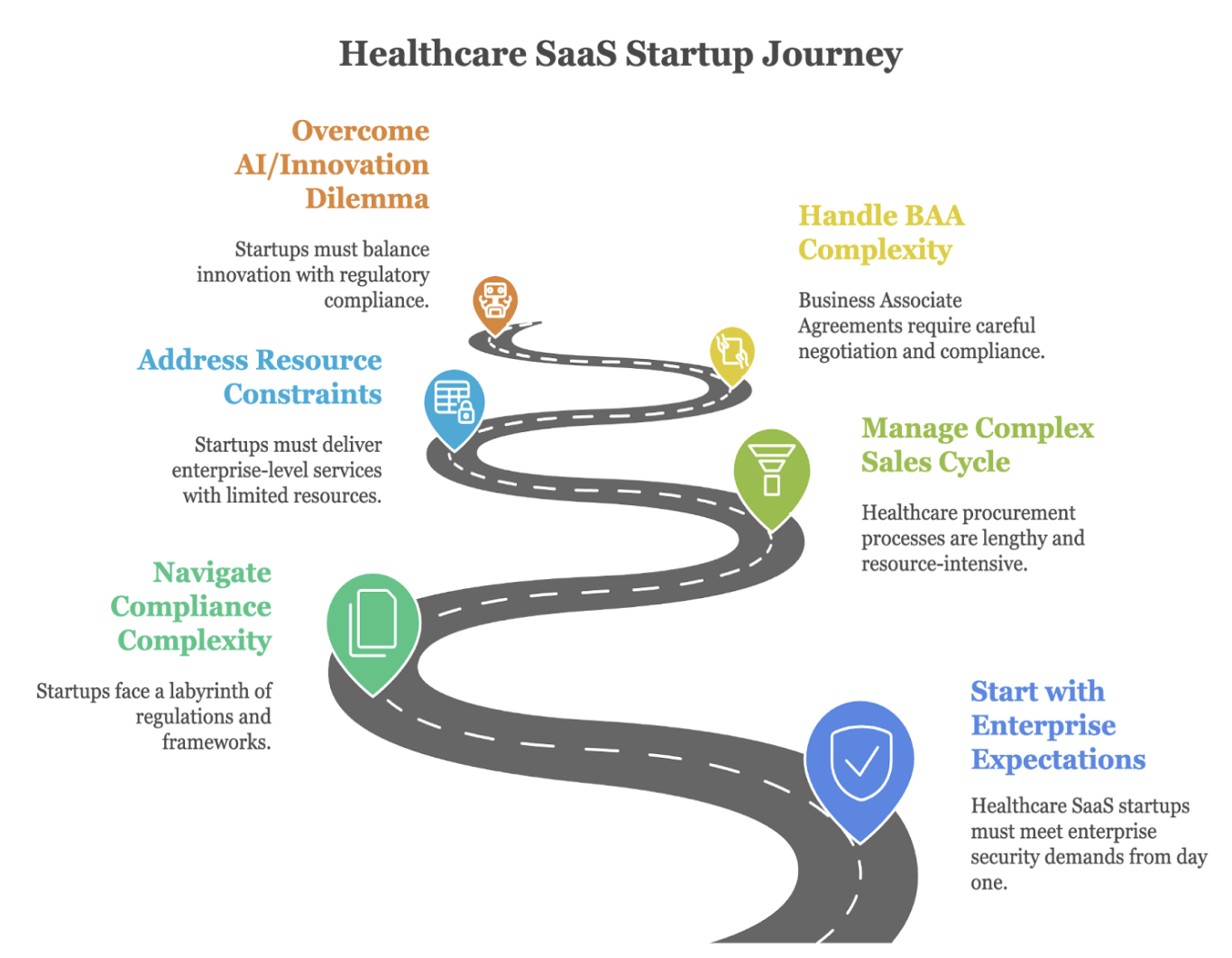
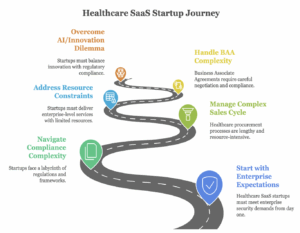
Challenge 1: Complex Compliance Requirements
The Problem: Healthcare SaaS must navigate a maze of overlapping regulations and frameworks from day one:
- HIPAA Security Rule: 36 required and addressable safeguards (administrative, technical, physical)
- HIPAA Privacy Rule: Patient rights, data use limitations, breach notification requirements
- State-Specific Laws: 50+ state breach notification laws, each with unique requirements
- Business Associate Agreements (BAAs): Legally binding contracts required with every customer
- SOC 2 Type II: Expected by 70%+ of healthcare organizations as baseline security proof
- HITRUST CSF Certification: Required by 80%+ of hospitals and health systems for vendor onboarding
Impact on Startups:
- Healthcare startups need to set aside a much bigger chunk of the funds for compliance than traditional SaaS companies do.
- Compliance expertise requires costly hires or consultants.
- Documentation requirements consume significant engineering time.
Challenge 2: Complex and Lengthy Sales Cycle
The Problem: Healthcare procurement processes are uniquely lengthy and resource-intensive and it is two to three times longer than traditional SaaS sales cycle.
Healthcare SaaS Sales Cycle:
- Community Hospital: 6-9 months
- Large Health System: 9-18 months
- National Payer: 12-24 months
Rigorous Procurement Process:
- Vendor Questionnaire: 100-300 security questions
- Security Review: InfoSec team evaluates architecture, policies, controls
- Legal Review: BAA negotiation, contract terms, liability caps
- Privacy Impact Assessment: HIPAA compliance validation
- Clinical Review: Physician or nursing leadership approval
- IT Review: Integration, data flow, technical feasibility
- Executive Approval: C-suite or board sign-off for major purchases
Startup Consequences:
- Sales team requires healthcare-specific expertise
- Significant deal delays caused by complex procurement processes.
Challenge 3: Resource Constraints vs. Enterprise Demands
The Problem: Healthcare customers treat 10-person startups the same as established enterprise vendors:
Customer Expectations:
- 99.9%+ uptime SLA (43 minutes downtime per month maximum)
- 24/7/365 support availability
- Disaster recovery plans with a tested failover
- Cyber insurance with $5M+ coverage minimums
- Annual and comprehensive third-party penetration testing
- SOC 2 Type II reports (12+ months of control operation)
The Gap: Startups must deliver Tier-1 enterprise vendor experience with 1/100th the resources.
Challenge 4: Business Associate Agreement (BAA) Complexity
The Problem: Every healthcare customer relationship requires a legally binding Business Associate Agreement with startup-unfavorable terms:
Typical BAA Terms:
- Unlimited Liability: Startup is liable for all HIPAA violations
- Breach Notification: 60 day notification requirement to Covered Entity
- Audit Rights: Customer can audit startup at any time, at startup’s expense
- Data Ownership: Customer owns all data; the startup is merely a custodian
- Indemnification: Startup indemnifies the customer for regulatory penalties
- Insurance Requirements: $2M-5M cyber liability policies (minimum)
- Breach Costs: Startup pays for credit monitoring, legal fees, and PR costs
- Termination Rights: Customer can terminate for convenience; the startup cannot
Startup Impact:
- Legal review costs: $5K-15K per major BAA negotiation
- Insurance premiums: $15K-50K annually (early stage)
- Deal velocity is slowed by legal back-and-forth, and zero negotiating leverage
Challenge 5: The AI/Innovation Dilemma
The Problem: Healthcare startups want to leverage AI and cutting-edge technology, but healthcare regulations haven’t caught up:
Innovation Desires:
- AI-powered diagnostic assistance
- LLM-based clinical documentation
- Predictive analytics for patient outcomes
- Machine learning for personalization
Healthcare Reality:
- AI model training on PHI requires strict data governance
- Model explainability requirements for clinical decisions
- FDA oversight potential for diagnostic AI
- Liability concerns for AI-generated clinical recommendations
- Data anonymization complexity
The Cost:
- Must anonymize data before AI training (complex, expensive)
- Regulatory uncertainty delays AI feature launches
Conclusion
Healthcare SaaS startups operate in a market where the stakes are high from day one. Enterprise-level security, rigorous compliance requirements, and lengthy, complex procurement processes create challenges that traditional SaaS companies rarely face. The combination of resource constraints, regulatory complexity, and zero tolerance for error can overwhelm even the most ambitious startups.
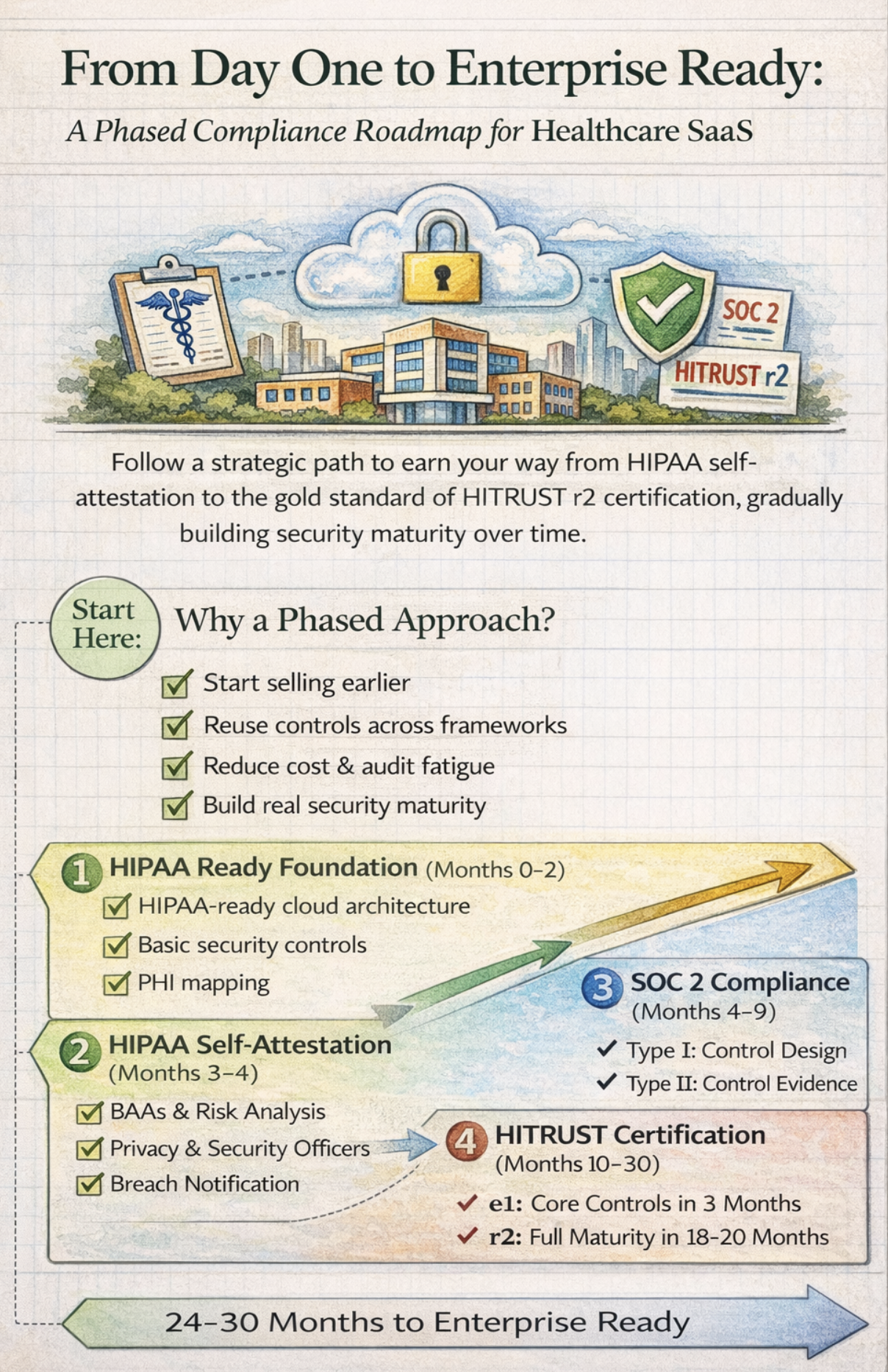
In Part 2 of this series, we outline a progressive compliance framework that turns these challenges into a clear, actionable roadmap.
At Prokopto, we specialize in guiding early-stage healthcare SaaS companies through these challenges. From establishing a strong compliance foundation to streamlining security processes, we help startups meet the demands of large healthcare providers without sacrificing innovation. By partnering with us, founders can focus on building transformative healthcare solutions while we navigate the regulatory and operational complexities, turning compliance and security from a barrier into a competitive advantage.